The Anatomy of a Veneer Sheet: Understanding Layers, Backing, and Face Quality.
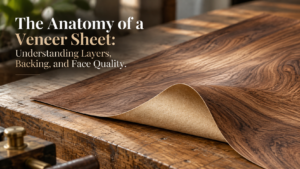
When you run your hand across a high-end luxury cabinet or a sleek modern conference table, you are likely feeling a wood veneer. To the untrained eye, it looks like a solid piece of hardwood. However, modern veneer sheet construction is a highly engineered process designed to maximize the beauty of rare woods while providing unparalleled structural stability.
Understanding the anatomy of a veneer sheet—from the delicate top cut to the hidden stabilizers—is crucial for architects, interior designers, and DIY woodworkers alike. Let’s peel back the layers to understand exactly what goes into a high-quality veneer sheet.
The Core of Veneer Sheet Construction

At its most basic level, a veneer is a microscopic slice of real wood. However, a raw slice of wood is incredibly fragile, prone to cracking, splitting, and reacting violently to humidity. To make this thin slice usable for furniture and architectural paneling, manufacturers bond it to various substrates.
The resulting composite relies on a specific sequence of wood veneer layers to ensure it remains flat, flexible, and visually stunning.
Decoding the Wood Veneer Layers
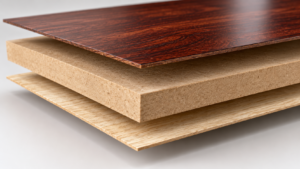
A standard engineered veneer panel typically consists of three distinct layers, each serving a critical function:
- The Face Veneer (Top Layer): This is the aesthetic layer. Sliced as thin as 0.6mm, the face veneer showcases the natural grain, figure, and color of the wood species (such as walnut, oak, or mahogany).
- The Core Substrate (Middle Layer): This is the structural foundation. Rather than solid wood, the core is usually Medium-Density Fiberboard (MDF), particleboard, or premium hardwood plywood. These engineered cores provide a flat, stable surface that doesn’t warp or swell like solid wood.
- The Balancing Veneer (Bottom Layer): Wood is hygroscopic; it absorbs and releases moisture. If you only apply a veneer to the top of a core board, the board will bow and warp as the top layer expands and contracts. A balancing veneer (often a cheaper, utility-grade wood) is applied to the underside to counteract this pull, keeping the entire panel perfectly flat.
The Role of Backing Materials in Flexible Veneer

Not all veneers are pressed onto thick MDF boards. For curved reception desks, rounded columns, or custom cabinetry, woodworkers use flexible veneer sheets. To prevent the delicate wood slice from shattering when bent, manufacturers fuse the raw wood to various backing materials.
Choosing the right backing is just as important as choosing the wood species:
- Paper Backing (10-mil and 20-mil): The most common backing material. A 10-mil paper backing is highly flexible and ideal for wrapping tight radiuses. The thicker 20-mil backing is stiffer, making it excellent for flat surfaces where you need to prevent the core’s texture from telegraphing through the veneer.
- Wood-on-Wood (2-Ply): This involves bonding the face veneer to a second, perpendicular layer of cheaper utility veneer. This cross-grain construction provides excellent dimensional stability and completely hides the substrate beneath, making it a favorite for high-end furniture.
- Phenolic Backing: Phenolic resin (similar to the backing on plastic laminates) creates an incredibly durable, waterproof, and rigid veneer sheet. It is ideal for high-traffic commercial environments, though it is less flexible than paper-backed options.
- Fleece or Fabric Backing: Often used in 3D wrapping or automotive dashboard interiors, fleece provides extreme flexibility, allowing the wood to be stretched and bent around complex, multi-directional curves without splitting.
Evaluating Face Quality and Grading
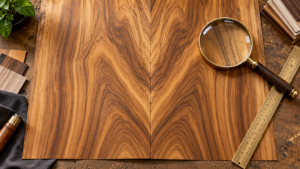
The top layer of your veneer sheet construction determines the visual success of your project. Face quality is strictly graded based on the presence of natural defects like knots, mineral streaks, and sapwood.
- AA Grade (Architectural): The pinnacle of veneer quality. Flawless grain, exact color matching, and zero defects. Used in private jets, luxury yachts, and high-end corporate boardrooms.
- A Grade: Excellent quality with highly consistent grain and minimal character marks. The standard for premium residential cabinetry and furniture.
- B & C Grades: These feature more natural variations, including visible pin knots and color variations. They are often used for rustic designs or interior cabinet linings where perfection is not required.
Frequently Asked Questions

What are the standard wood veneer layers?
A fully constructed veneered panel consists of three layers: a decorative face veneer on top, a stable engineered core (like MDF or plywood) in the middle, and a balancing veneer on the bottom to prevent the panel from warping.
Which backing materials are best for curved surfaces?
For curved surfaces, a 10-mil paper-backed veneer or a fleece-backed veneer is best. These backing materials provide maximum flexibility, allowing the wood to bend tightly around radiuses without cracking or splitting.
Why is a balancing veneer necessary?
A balancing veneer is necessary to equalize moisture absorption and tension on both sides of a core panel. Without it, the face veneer will expand or shrink independently, causing the entire wooden panel to severely warp or cup.
Conclusion
The true beauty of a veneer sheet lies not just in its outward appearance, but in the sophisticated engineering hidden beneath the surface. By understanding the intricacies of veneer sheet construction, the specific functions of different wood veneer layers, and the mechanical advantages of various backing materials, you can select the perfect product for your next build. Whether you are crafting a curved executive desk or refacing kitchen cabinets, knowing the anatomy of your materials guarantees a flawless, long-lasting finish.