The Metallic Bull & Pommelle Collection: Adding a Shimmering Edge to Natural Wood
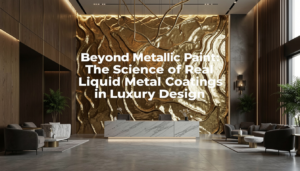
Architects and designers chasing true metallic expression often hit the same barrier: sheet metal. Its extreme weight, tight limits on bending radii, and unavoidable welded seams force compromises in form, installation, and aesthetic purity. Real liquid metal coatings offer a different path—preserving slender, seamless silhouettes while delivering authentic metal appearance and performance.
The Illusion of Metallic Paint vs. The Reality of Metaluxe
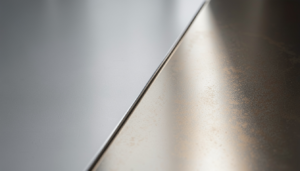
At a glance, metallic paint and real metal finishes can look similar, but their makeup and behaviour are fundamentally different. Standard metallic paint achieves shine by suspending reflective mica or aluminum flakes in a binder; the result is a surface that mimics metallic luster but lacks depth, conductivity, and true metal properties. Metaluxe, by contrast, is an advanced cold-metal coating composed of up to 95% pure, pulverised metal bonded into a proprietary matrix, creating an actual metallic skin that can be formed, repaired, and finished like solid metal. This real liquid metal coating replicates the tactile weight, thermal response, and patination potential of traditional metals while remaining lightweight and adaptable to complex geometries.
The Science Behind the Seamless Skin
1. The Liquid Cold-Spray Application
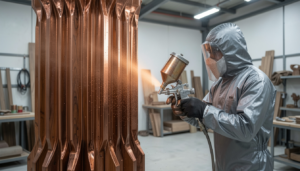
Because Metaluxe begins as a true liquid metal system, it can be atomized or applied with a trowel to follow the smallest architectural cues—mouldings, carved wood grains, and flowing column capitals—without bridging, cracking, or hiding detail. The fluid rheology is engineered so metal-rich particles remain suspended uniformly, enabling ultra-thin, continuous layers that conform to compound curves and undercuts. This wet-state workability lets designers preserve delicate profiles while achieving a monolithic metal finish across disparate materials and assemblies.
2. The Curing and Bonding Process
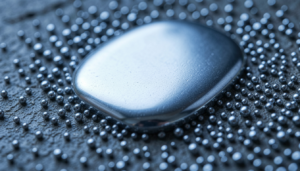
Curing is driven by a proprietary binder chemistry that chemically locks the pulverised metal into a cohesive matrix and forms covalent or ionic bonds with the substrate surface, depending on its composition. The result is a permanent, structural skin—mechanically interlocked and chemically adhered to MDF, fiberglass, concrete, or existing metals—so the coating behaves as an integral part of the element rather than a surface film. Final post-cure densification and optional heat or catalytic treatments further consolidate conductivity, hardness, and patination potential for a finish indistinguishable from solid metal.
3. The Activation and Polishing Phase
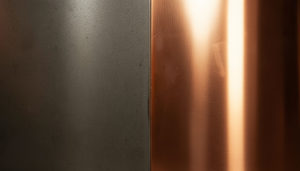
This is the most crucial step: after full cure, technicians abrade the thin binder-rich skin to reveal the dense, raw metal layer beneath, exposing the up-to-95% metal content. Once exposed, the surface responds exactly like bulk metal—it can be high-gloss polished to mirror sheen, matte-brushed for soft reflection, or chemically activated to develop authentic rust or verdigris patinas. The result is a seamless metal finish that carries true metal tactile qualities, thermal response, and aging behavior while remaining bonded to lightweight, complex substrates.
Why Luxury Developers are Replacing Sheet Metal
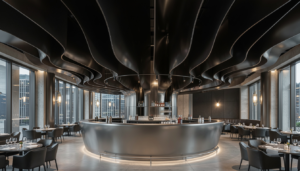
Developers and builders in hospitality and high-end residential projects increasingly specify real liquid metal coatings because they convert design intent into buildable, profitable reality without compromise. The technology reduces installation time and subcontractor complexity while preserving authentic metal performance and long-term serviceability. Below are three concrete, business-focused advantages to specify in tender documents or value-engineering meetings:
- Monolithic aesthetics: Achieve truly seamless surfaces—zero joint lines on massive reception desks, continuous wall cladding, and uninterrupted ceiling planes—reducing the need for complex seam-mitigation details and costly patchwork.
- Extreme weight reduction: Replicate the look and thermal feel of solid brass or bronze on lightweight substrates, enabling ceiling baffles, suspended canopies, and decorative screens on MDF or composite cores without reinforcing structure.
- Boundless creative freedom: Allow bespoke furniture and sculptural elements to be produced in-house or locally, with complex curves, thin sections, and integrated detailing that sheet metal fabrication cannot economically deliver.
Conclusion
Liquid metal technology removes the last barriers between structural imagination and physical reality, enabling designers to translate ambitious forms into lightweight, durable, and authentically metallic surfaces without the compromises of sheet metal. Contact our design and construction team to explore how Metaluxe can elevate your next signature restaurant bar, hotel lobby, or bespoke villa interior—together we’ll specify finishes, review mock-ups, and integrate a tailored installation plan that turns visionary design into lasting presence.
Book a consultation with our interior design and construction team today. We’ll guide you in choosing top-tier materials and expert craftsmanship.